Sixty percent of AI leaders say legacy system integration is their primary barrier to AI automation — but the real blocker is rarely technical. It is an organizational ownership problem: the system's controller has no incentive to accept the integration risk, and the AI program has no mechanism to resolve that misalignment.
TL;DR
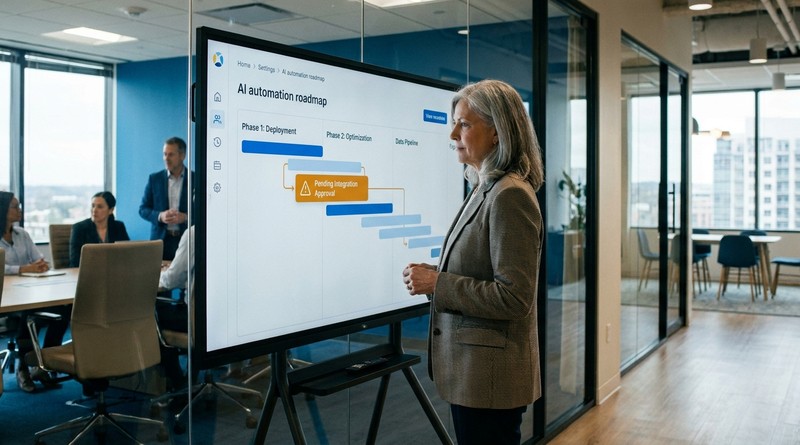
AI automation roadmaps stall in legacy-heavy enterprises not because the technical integration is impossible, but because the business unit that owns the legacy system has no incentive to accept the change risk the integration requires. When that organizational problem is misdiagnosed as a technical one, programs either wait indefinitely for system owner approval or route around the dependency with ungoverned workarounds that create exactly the compliance exposure the program was designed to avoid. The resolution is to assign the integration as a formal governance decision: define the scope, quantify the deferred ROI, allocate the risk explicitly to a P&L owner who receives a proportional benefit share, and record the approval formally. CloudApper AI's iPaaS integration layer provides the bounded, governed interface that makes a system owner's risk acceptance technically defensible and organizationally executable.
Table of Contents
- The AI Automation Dependency Nobody Documents
- Why the Technical Path Is Often Clear and the Organizational Path Is Not
- The Application Owner Problem
- What the Legacy API Dependency Actually Costs the AI Roadmap
- How to Reframe the Integration as a Governance Decision
- How to Assign Legacy Integration Risk to a P&L Owner
- Frequently Asked Questions
The legacy system holding up your enterprise AI roadmap usually has a workable API integration path. What it lacks is an owner with any reason to approve it. Wrapping a manufacturing execution system, an old ERP module or a claims platform in an integration layer is a well-understood problem, but the application owner gets none of the automation benefit and all of the change risk.

So the request sits in that owner’s queue under a risk assessment that is ninety days old and still open. CloudApper AI, a governed platform for building, extending and modernizing enterprise applications, was built around this point: the technical constraints are almost always resolvable, and the organizational ones need a governance decision.
The AI Automation Dependency Nobody Documents
When an enterprise begins planning an AI automation initiative, the workflow the initiative targets typically includes at least one legacy system that carries business-critical data. Order history. Patient records. Supply chain transactions. Payroll. The AI agent that is supposed to automate the workflow needs to read from that system, and in many cases write to it as well.
The dependency is documented in the architecture diagram. It is labeled “legacy ERP integration” or “legacy MES connector” or some equivalent shorthand. What the architecture diagram does not document is who owns the change risk associated with exposing that system to an integration layer, whether the system’s current operating model supports the transaction volume and data access patterns the AI agent will generate, or what the rollback plan looks like if the integration causes an incident during a period the business unit considers high-stakes.
According to research reported from Deloitte Tech Trends 2026, 60 percent of AI leaders identify legacy system integration as their primary barrier to agentic AI implementation. A Google Cloud analysis found that 43 percent of IT leaders cite difficulty integrating legacy APIs and data sources as the largest infrastructure gap preventing organizations from scaling AI automation. More than half of enterprise leaders — 56 percent, according to separate analysis — name legacy systems and technical debt as the primary constraint on realizing AI gains.
These numbers are usually read as a technical problem. They are not. An enterprise AI transformation plan has dependencies that are not purely technical — and the most difficult to resolve is the one that lives inside a legacy system’s ownership structure, not inside the system itself.
Why the Technical Path Is Often Clear and the Organizational Path Is Not
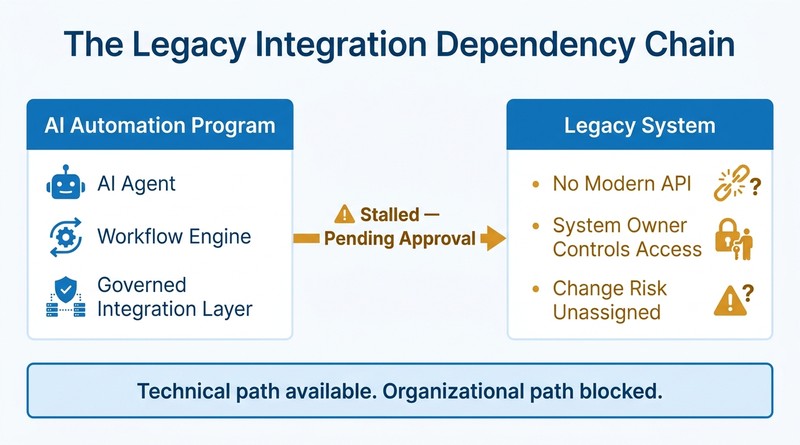
Most legacy systems without modern REST APIs are not, in fact, technically impossible to integrate with AI automation workflows. The technical options are well established. A thin middleware wrapper can expose read-and-write endpoints without touching the core system. A change data capture layer can stream transactions to a modern data platform where the AI agent operates against a governed replica. A workflow API can observe and reconstruct the request patterns the system already accepts from its own UI, exposing them as callable endpoints. For systems where none of these approaches are viable, a human-in-the-loop automation layer can route AI-generated outputs through a staffed review step while the longer-term integration architecture is built.
None of these approaches are fast, and several of them carry meaningful operational risk during implementation. But they are technically available to most enterprises. The reason they are not executed is rarely that the technical team cannot design the integration. It is that no one has answered the organizational question the integration requires: who accepts the operational risk if the middleware wrapper causes a data inconsistency, and whose budget funds the remediation?
The institutional knowledge problem that sits inside legacy systems compounds this. Many of the application owners who control these systems have been running them for years. They know what the system can tolerate and what it cannot. They have seen integrations fail in ways that took days to remediate. Their caution is not irrational — it is the rational response of someone who is accountable for operational continuity and has no explicit accountability for the AI automation initiative that is asking them to accept new risk.
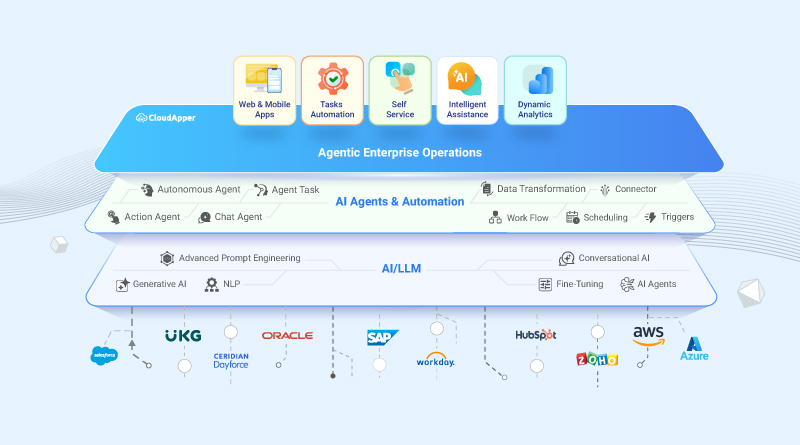
CloudApper AI’s iPaaS integration layer was designed with this dynamic in mind: the platform creates a governed intermediary between the legacy system and the AI automation layer, so the system owner can accept a defined, bounded integration scope rather than an open-ended technical dependency. But even that approach requires a decision from the system owner to engage — and that decision will not happen without a governance structure that explicitly assigns the integration as a shared organizational responsibility rather than an IT project.
The Application Owner Problem
The stakeholder who is almost never present in the AI automation roadmap conversation is the person who actually controls the legacy system — typically a business unit manager, a long-tenured application owner, or a department head who inherited operational responsibility for the system years before AI automation was part of any enterprise planning conversation.
From that person’s perspective, the AI integration request is an uncompensated operational risk. Their team will be asked to support integration testing during a period when they are already managing normal operations. Any incident caused by the integration will appear in their operational record, not in the AI program’s. If the integration succeeds, the AI automation benefit accrues to another business unit or to a program-level ROI target that has no direct relationship to their performance metrics.
The result is a predictable dynamic: the system owner does not formally block the integration. They request assessments, invoke change-control procedures, raise questions about vendor security reviews, and ask for additional documentation. None of these requests are unreasonable. All of them are also structurally incentivized by the ownership model that assigns them the risk and gives someone else the reward.
This is the argument that backfires when framed incorrectly: suggesting that the system owner is being obstinate, or that faster technology will route around their objections, typically destroys the collaborative relationship the integration will eventually require. Shadow AI development that circumvents the system owner creates a parallel data dependency with no governance backing — and when it breaks, it breaks against production data that the shadow integration was never authorized to touch.
The only productive path is to make the system owner’s risk explicitly visible, compensate them for accepting it, and give them a defined exit from accountability if the integration follows the agreed operating model. That is an organizational governance decision, not a technical one.
What the Legacy API Dependency Actually Costs the AI Roadmap
The standard framing of the legacy integration problem treats it as a delay. The AI roadmap item is deferred by one quarter, then two, then it becomes a “Phase 2” item with no committed date. This is how most organizations experience the problem — as a slowdown.
The actual cost is different. When an AI automation initiative cannot integrate with the legacy system that holds the relevant data, the automation program either stalls entirely or routes around the dependency. Routing around it means one of two things: the AI agent operates on a data subset that does not include the legacy system’s records, producing outputs that are incomplete from an operational standpoint; or the team builds an unmanaged workaround — a data export, a manual synchronization process, a shadow integration — that creates exactly the compliance and governance exposure the original program was designed to avoid.
The cost of maintaining a system your vendor no longer supports is already significant. The cost of an AI automation program that cannot access that system’s data without a workaround is additive — and it accumulates with each quarter the integration decision is deferred.
The CFO-level framing, which is what makes this argument forwardable beyond the IT steering committee, is this: the AI automation program’s ROI projection assumed access to the legacy system’s data. Every quarter that access is deferred is a quarter of that ROI projection that does not materialize. The integration risk that the system owner is managing is real and should be priced and assigned — but it is almost certainly smaller than the compounding opportunity cost of an AI automation program running at partial capacity.
How to Reframe the Integration as a Governance Decision
The practical step that most AI automation programs skip is assigning the legacy integration as a governance decision with explicit ownership, rather than treating it as a technical workstream with an implicit owner. The distinction matters because governance decisions can be escalated, tracked, and resolved by executive authority. Technical workstreams can be deferred indefinitely by anyone in the dependency chain.
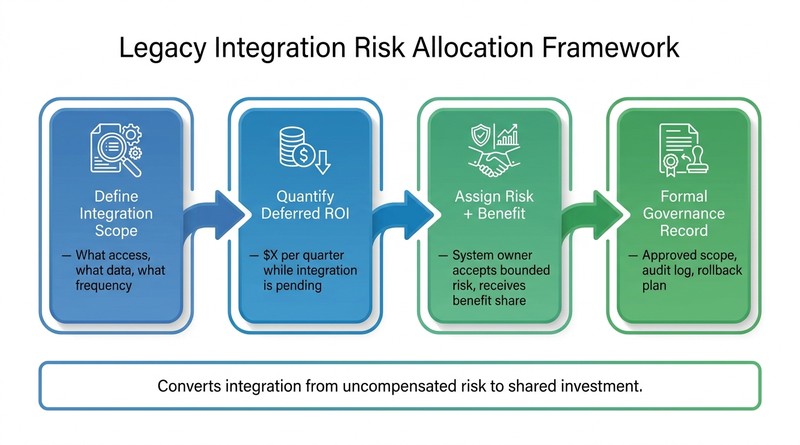
A governance assignment for a legacy integration has three components. First, a defined integration scope: what data the AI automation layer will read, what it will write, at what frequency, and under what access control model. This scope becomes the formal boundary of the system owner’s risk acceptance, and it limits what can change without a new governance decision. Second, an explicit risk allocation: who accepts operational accountability for incidents caused by the integration, and what remediation budget is associated with that allocation. Third, a benefit attribution: what portion of the AI automation program’s projected ROI is assigned to the system owner’s unit, creating an incentive structure that is proportional to the risk they are being asked to accept.
Modernization without governance creates new risk at exactly the point the organization least expects it — and that observation applies to AI automation integrations as much as to formal modernization programs. The iPaaS integration layer that CloudApper provides for legacy system connectivity is a technical enabler, but the governance assignment is what makes the integration executable.
How to Assign Legacy Integration Risk to a P&L Owner
- Map the dependency explicitly in the AI roadmap. For each AI automation initiative, document every legacy system the agent reads from or writes to, the system’s current owner, the last formal change review that system underwent, and the estimated transaction volume the AI integration will generate. This makes the dependency visible to executive sponsors, not just to the technical team.
- Quantify the deferred ROI. Calculate what portion of the AI automation program’s projected benefit depends on access to each legacy system. Express this as a quarterly figure. The system owner who is deferring the integration decision should see the dollar amount of AI program ROI that is not materializing each quarter the decision is pending — not as a pressure tactic, but as the information needed for a rational risk-versus-benefit assessment.
- Define the integration scope formally before requesting system owner approval. Bring the system owner a bounded scope document, not an open-ended integration request. The scope should specify exactly what access the AI layer will have, what change control procedures apply to modifications of that access, and what constitutes a scope violation that triggers a governance review. A bounded request is easier to approve than an open-ended one.
- Assign an explicit benefit share to the system owner’s unit. If the AI automation initiative produces efficiency gains, cost reductions, or revenue improvements, designate a portion of that value as attributable to the system owner’s contribution. This converts the integration from an uncompensated risk to a shared investment with a defined return.
- Establish a formal risk acceptance record. When the system owner approves the integration, document the approval as a formal governance record: what scope was approved, who accepted operational accountability, what remediation process applies to incidents, and when the integration will be reviewed. This record protects the system owner from being held accountable for incidents outside the approved scope and gives the AI program a defined operating boundary.
- Build the integration on a governed platform layer. A direct point-to-point connection between the AI automation layer and the legacy system creates a dependency that is difficult to audit, difficult to change without risk, and difficult to document for compliance purposes. A governed integration platform — one that logs all transactions, enforces the access scope defined in the governance record, and provides a defined rollback mechanism — gives the system owner the technical assurance that makes organizational approval achievable. This is the architecture CloudApper AI implements through its iPaaS layer: the legacy system sees a governed, bounded interface, and the AI automation layer sees a stable, auditable data surface.
Frequently Asked Questions
- Why do most legacy systems lack the APIs that AI automation requires?
- Legacy systems were designed before API-first architecture became standard practice. Their data access patterns were built for the applications that ran at the time of implementation, not for programmatic access by AI agents or external automation layers. The absence of an API is not a design failure by those systems’ standards — it is a mismatch between a system designed for one era’s integration patterns and the requirements of a current AI automation program.
- What is the difference between a legacy system integration problem and a legacy system modernization program?
- A legacy system integration creates an interface between the existing system and a new capability — AI automation, a modern data platform, or an application built on a governed platform — without changing the system itself. Modernization replaces or re-architects the system so that it operates on current infrastructure with current integration standards. Integration is faster and less disruptive; modernization is more durable and eliminates the underlying architectural debt. Most enterprises need both, sequenced in a way that allows AI automation to move forward before modernization is complete.
- How should a CIO handle a legacy system owner who is not responding to an integration request?
- Escalation is rarely the right first move. The more productive approach is to make the system owner’s risk visible and compensated. Present the integration as a bounded scope with explicit risk allocation and a defined benefit share for the system owner’s unit. If the system owner still does not engage after a formal scoped request, the escalation is from the CIO to the executive who owns both the AI program and the system owner’s business unit — framed as a resource allocation decision, not a performance issue.
- What compliance risks does a legacy system integration create for AI automation programs?
- The primary compliance risk is data access without governance documentation. An AI agent that reads from a legacy system containing regulated data — patient records, financial transactions, personnel files — without a formal data access record, access control configuration, and audit log creates exactly the compliance exposure that the enterprise’s HIPAA, SOC 2, or FIPS controls are designed to prevent. The integration architecture must produce an auditable record of what data was accessed, when, by which automated process, and under what authorization. A governed integration platform provides that record by design; a direct or ad-hoc integration typically does not.
- Why do AI automation programs route around legacy dependencies instead of resolving them?
- Because routing around the dependency is organizationally faster than resolving the ownership and governance questions the integration requires. A data export, a manual sync, or a shadow integration can be implemented by the AI program team without involving the system owner. The governance exposure that creates is deferred, not eliminated — and when it surfaces in an audit or an incident, it is more expensive to remediate than the integration decision would have been to make.
- How does CloudApper AI address the legacy integration problem?
- CloudApper AI provides an iPaaS integration layer that creates a governed, bounded interface between legacy systems and AI automation workflows. The interface is defined by a formal integration scope, logs all transactions for audit purposes, enforces the access control model agreed with the system owner, and provides a rollback mechanism. This architecture gives system owners the technical assurance needed to approve a bounded integration scope and gives the AI program a stable, compliant data surface that does not require ad-hoc connections to legacy infrastructure.
For organizations working through legacy integration dependencies that are blocking AI automation programs, CloudApper AI provides a governed integration platform that gives system owners and IT leadership a defined, auditable path from legacy dependency to operational AI. To discuss your integration architecture, visit CloudApper’s contact page.

What is CloudApper AI Platform?
CloudApper AI is an advanced platform that enables organizations to integrate AI into their existing enterprise systems effortlessly, without the need for technical expertise, costly development, or upgrading the underlying infrastructure. By transforming legacy systems into AI-capable solutions, CloudApper allows companies to harness the power of Generative AI quickly and efficiently. This approach has been successfully implemented with leading systems like UKG, Workday, Oracle, Paradox, Amazon AWS Bedrock and can be applied across various industries, helping businesses enhance productivity, automate processes, and gain deeper insights without the usual complexities. With CloudApper AI, you can start experiencing the transformative benefits of AI today. Learn More
- Useful Links:
- Agentic AI
- No-Code/Low-Code
- Custom Software
- HCM Personalization
- iPaaS
- FedRAMP
CloudApper AI Solutions
- Works with







- and more.
Similar Posts

Vendor-Built Internal Applications: The Governance Gap Enterprise IT Inherited From…

What Your AI Development Platform Vendor’s Security Review Should Actually…