Defense contractors building internal applications that handle CUI face a critical CMMC Level 2 gap: evidence doesn't update automatically when AI tools or citizen developers change data flows. This article explains what continuous evidence automation looks like in practice and why it matters before assessment.

TL;DR
CMMC Level 2 assessors evaluate evidence quality across an organization's entire application environment, and internally developed applications that handle Controlled Unclassified Information must maintain current documentation for access controls, audit logging, change management, and CUI data flow mapping. The compliance gap is not in understanding which controls apply but in capturing evidence continuously as applications change. Defense contractors that build inside a governed platform inherit NIST 800-171 controls by design and generate assessment-ready evidence automatically, rather than reconstructing it before each assessment window. For organizations where DoD contracts represent material revenue, the cost of a failed assessment or a development freeze is a business continuity risk, not a compliance checkbox.
Table of Contents
Your CMMC Level 2 assessor asks one question: “Show me every system in your environment that stores, processes, or transmits CUI.” The room gets quiet — not because nobody knows the answer, but because two people in the room know the answer is incomplete. An internal application your logistics team built eight months ago added a new integration last quarter. Nobody updated the System Security Plan.

That is the CMMC Level 2 compliance gap that most defense contractors are not closing before assessment. It is not a question of which controls apply. Every IT director managing a DoD supply chain understands the 110 NIST SP 800-171 requirements well enough. The gap is that internally built applications change faster than the documentation that covers them — and the evidence auditors need to verify compliance does not generate itself.
When Scope Gets Complicated
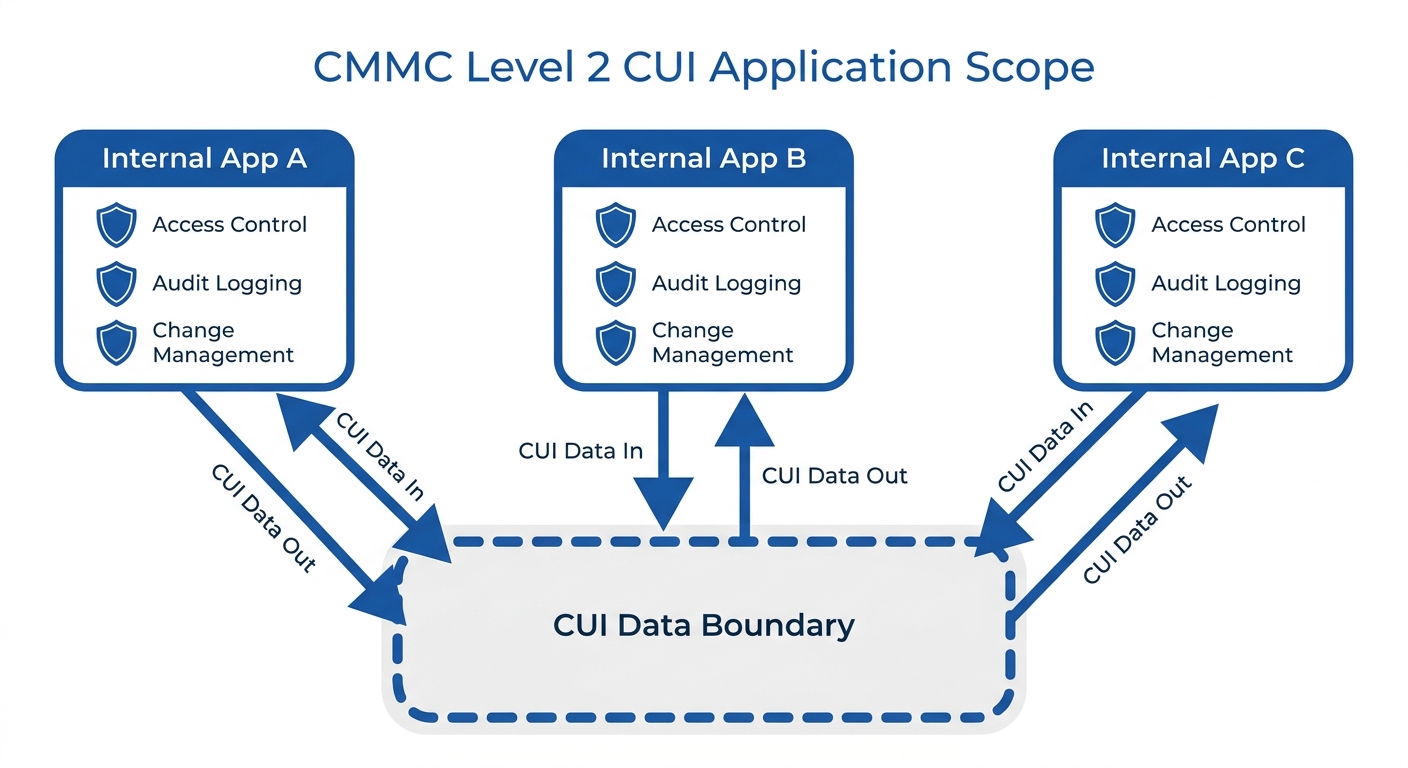
CMMC assessment scope includes every asset, system, and application within the boundary of Controlled Unclassified Information flow. For organizations where internal app development happens regularly — a scheduling tool built on a low-code platform, a supplier intake form that pulls from a CUI-containing database, a reporting dashboard built by an operations analyst — that scope is not static. CUI flow paths shift every time a developer adds an API connection, a business unit expands a data field, or an AI coding assistant generates a new module.
The scoping problem compounds because internally developed applications often grow outside formal IT project pipelines. A team needed something, someone built it, and now it touches controlled data. The application may not appear on the current asset inventory. Its access controls may never have been formally reviewed. Its audit logging may not meet the CMMC audit and accountability requirements under NIST 800-171 control family 3.3. And when an assessor asks for evidence of those controls, the answer is a spreadsheet, a best-effort reconstruction, and a POA&M.
As compliance teams discover when SOX auditors add an internal application to scope, the documentation burden is the hardest part — not the controls themselves. CMMC makes that burden heavier because the evidence requirements are more prescriptive and the consequence of a failed assessment is contract eligibility.
The Evidence Automation Problem
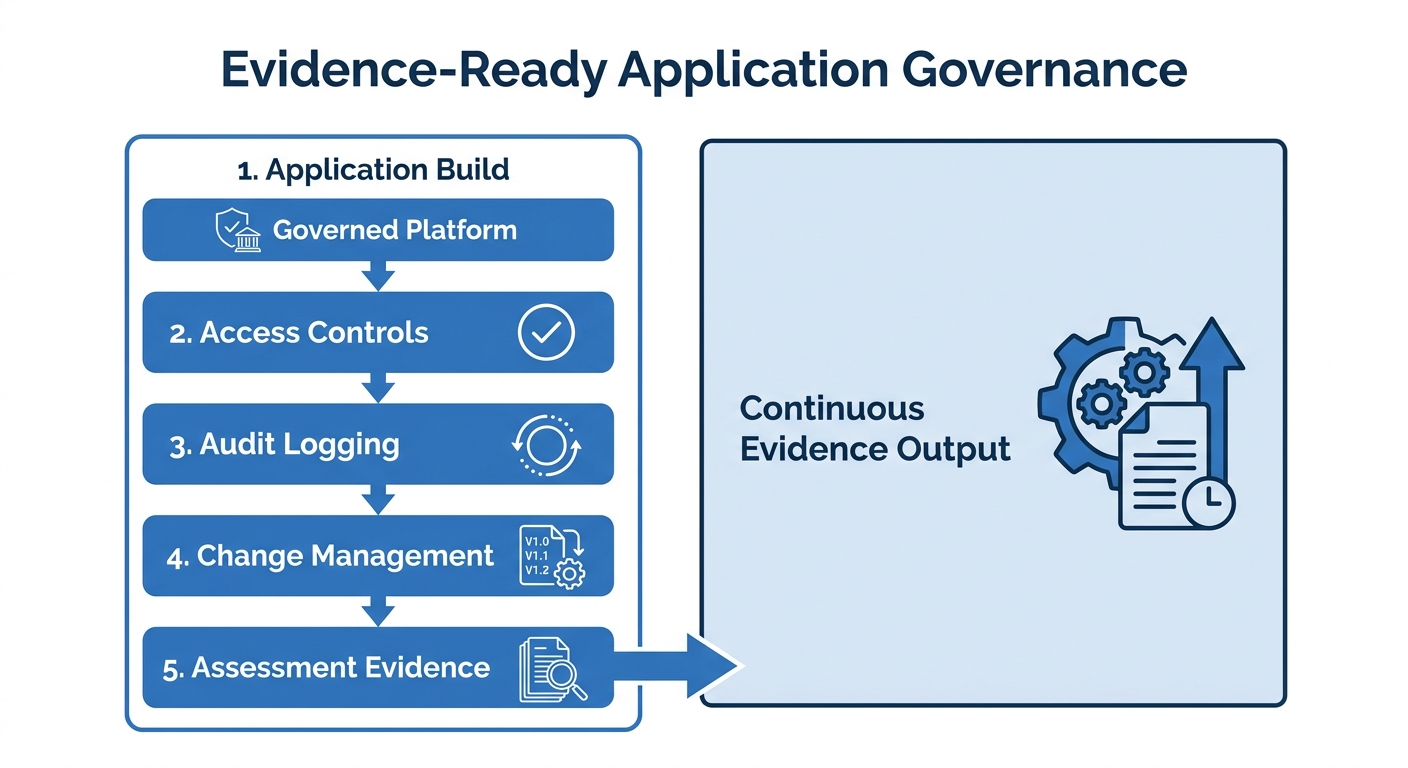
The argument that backfires is claiming a governed platform will help a defense contractor pass their CMMC assessment faster. Assessors evaluate the evidence quality across the entire environment, not the tool used to build one application. What a governed platform can do is generate and maintain that evidence continuously, at the application level, in a format auditors can actually use.
That is a different claim — and a defensible one. When a citizen developer or an AI coding assistant changes an internal application’s data flow or access pattern, a governed platform can record that change, capture what access controls were in place before and after, log who made the change and when, and reflect that in the application’s security documentation. The governance framework for AI-assisted development has to operate at this level of granularity to mean anything during a CMMC assessment.
The hidden risk of ungoverned AI coding tools in a defense contractor environment is precisely this: the code changes faster than the evidence captures it. An AI coding assistant can generate a working module in an afternoon. The SSP update, the access control review, the audit log configuration — those take days, and they rarely happen at the same pace as the build.
What CUI Flow Mapping Requires in Practice
For a CMMC Level 2 assessment, internally developed applications handling CUI need documented evidence of access control (3.1), audit and accountability (3.3), configuration management (3.4), identification and authentication (3.5), incident response (3.6), risk assessment (3.11), system and communications protection (3.13), and system and information integrity (3.14). That is not a comprehensive list — it is the minimum that appears on every walkthrough.
For each application, that means: a current data flow diagram showing CUI entry and exit points, access control documentation tied to specific user roles, audit log configuration with retention periods, a change management record showing who modified the application and when, and evidence that the production environment is separated from development and test. For an application built organically over eighteen months by multiple contributors, reconstructing that evidence from memory is not realistic. The documentation standard enterprise IT actually owes compliance auditors requires that these records exist in real time, not in retrospect.
A director of IT at a defense logistics company described this exact problem: they had seven internal applications touching CUI across three facilities, built incrementally over four years, with inconsistent documentation and no centralized change management. She described what they needed to CloudApper AI — a governed environment where every internally built application inherited NIST 800-171 controls by design, generated audit evidence automatically, and maintained a current data flow map as configurations changed. The platform had the governed environment ready without a six-month implementation project. What a security review of an AI development platform should actually cover includes exactly these inherited controls — not promises, but verifiable architecture.
The Business Risk Question Before Assessment
A failed CMMC Level 2 assessment or a deficient triennial re-assessment does not result in a fine. It results in a contract. Defense contractors cannot be awarded DoD contracts requiring CMMC Level 2 certification until they demonstrate compliance. For organizations where government contracts represent a material share of revenue, freezing internal application development for six to nine months during an assessment window — to prevent any new changes from expanding scope — is not a compliance decision. It is a business continuity decision.
CISA’s guidance on software supply chain security and the DoD’s CMMC scoping documentation both reinforce the same point: the application boundary is not static, and evidence requirements apply to every change within it. The organizations that enter CMMC assessments with confidence are not the ones that built better applications. They are the ones that built applications inside an environment where governance evidence is a continuous output, not a pre-assessment scramble.
What enterprise teams get wrong about compliance-ready development is treating it as a documentation exercise rather than an architectural one. CMMC Level 2 compliance for internal applications is not a matter of filling out the right forms. It is a matter of building inside a platform where the controls are already there, the evidence is already being captured, and a change in one module does not create an undocumented compliance exposure three months before assessment.
If your organization is evaluating how to govern internally developed applications ahead of a CMMC Level 2 assessment, CloudApper AI can walk you through what an evidence-ready governed environment looks like in practice. Start the conversation here.

What is CloudApper AI Platform?
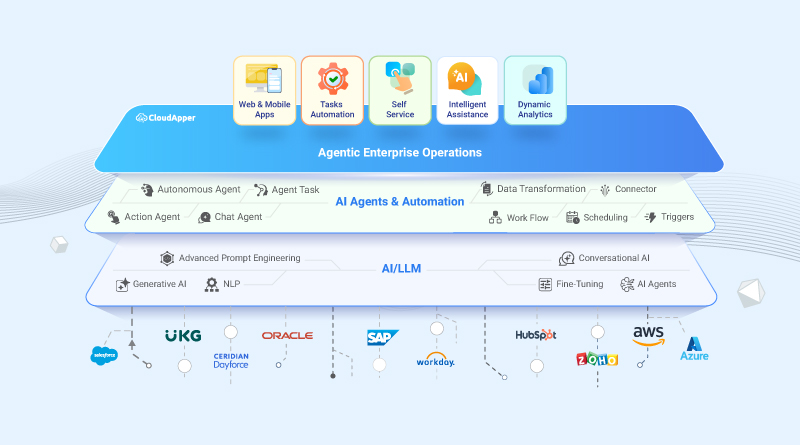
CloudApper AI is an advanced platform that enables organizations to integrate AI into their existing enterprise systems effortlessly, without the need for technical expertise, costly development, or upgrading the underlying infrastructure. By transforming legacy systems into AI-capable solutions, CloudApper allows companies to harness the power of Generative AI quickly and efficiently. This approach has been successfully implemented with leading systems like UKG, Workday, Oracle, Paradox, Amazon AWS Bedrock and can be applied across various industries, helping businesses enhance productivity, automate processes, and gain deeper insights without the usual complexities. With CloudApper AI, you can start experiencing the transformative benefits of AI today. Learn More
- Useful Links:
- Agentic AI
- No-Code/Low-Code
- Custom Software
- HCM Personalization
- iPaaS
- FedRAMP
CloudApper AI Solutions


- Works with







- and more.
Similar Posts

Vendor-Built Internal Applications: The Governance Gap Enterprise IT Inherited From…

What Your AI Development Platform Vendor’s Security Review Should Actually…