ISO 42001 applies to every organization using AI systems, including enterprise IT teams using AI coding tools to build internal applications. Most enterprises have no governance record for AI-generated code already in production. Here is what that gap looks like and how to close it.

TL;DR
ISO 42001, the AI Management System standard published in December 2023, applies to any organization using AI systems -- including enterprise IT teams using AI coding tools to build internal applications. Most enterprises have no governance record for AI-generated code already in production. The standard requires documented human oversight, risk assessment, and accountability chains that current change-control processes were never designed to produce. Enterprise IT leaders are reframing their approach: building applications on governed platforms like CloudApper AI that produce compliance evidence as a structural output of the development process, not as retroactive documentation.
Table of Contents
ISO 42001 Is Looking at the Code Your AI Coding Tools Already Shipped
The auditor asked one question: “Can you show me the review record for the AI-generated portions of your Q2 deployment?” Nobody reached for a laptop. The application had been in production for four months, handling claims data for a regional insurance subsidiary. It worked. No one questioned it at go-live. And there was no documentation showing who had reviewed the AI-generated code, what risk assessment had been done, or who had accepted accountability for it. The application existed. The evidence did not.

That is the gap ISO 42001 is now formalizing.
ISO/IEC 42001, the AI Management System standard published in December 2023, does not apply only to companies that build AI products. It applies to organizations that use AI systems — and by any reasonable reading, every enterprise IT team using GitHub Copilot, Cursor, Amazon Q, or similar tools to build internal applications is using an AI system in its development process. ISO 42001 expects that process to be governed. Most enterprise IT teams do not govern it.
The Evidence Problem Is Already in Production
AI coding tools did not create the documentation problem in enterprise development. They accelerated it in a direction that existing change-control processes were never designed to handle. When a developer writes code, there is an author. When an AI tool generates code, there is a prompt and an output — and the question of who reviewed it, what they checked, and whether the review met any defined standard is left to the team without any structural prompt to answer it. The security testing gap in AI-generated code is well-documented, but the governance record gap is different: it is not about whether the code was tested, but whether there is an auditable chain of accountability from the AI tool to the production deployment.
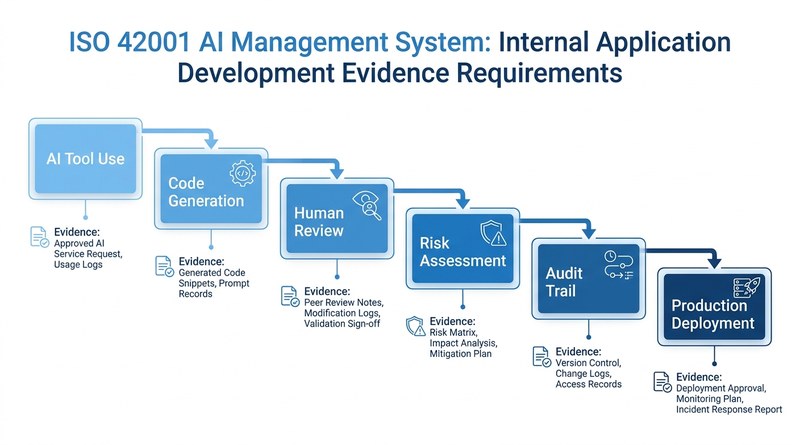
ISO 42001 requires exactly that chain. Its controls around human oversight, risk assessment, and documented accountability are the minimum evidence baseline for any organization governing AI use in a way that can withstand external review. The evidence gap that NIST AI RMF exposed for internally built applications is structurally identical: the framework exists at the policy level, but the artifacts that prove conformance do not, because the build process never produced them.
For enterprise IT teams, the evidence problem is concrete. Developers use AI tools daily, but no one has formally catalogued which tools are approved, defined a review step for AI-generated code, or formalized the risk assessment ISO 42001 expects — covering data exposure during code generation, AI-introduced vulnerability classes, and human oversight accountability. Adding governance to AI coding tools is possible. Most teams have not done it because no compliance mandate made it urgent. ISO 42001 is making it urgent.
The Retroactive Problem No One Wants to Own
The harder challenge is not ISO 42001 readiness for future applications. It is the applications already running in production that were built with AI tools before anyone asked these questions. The documentation gap the EU AI Act surfaces for internally built applications follows the same structure: requirements defined at the organizational level that were never injected into the build process at the application level. When the audit arrives, the gap is not in the policy. It is in the absence of evidence that the policy was followed when the code was written.
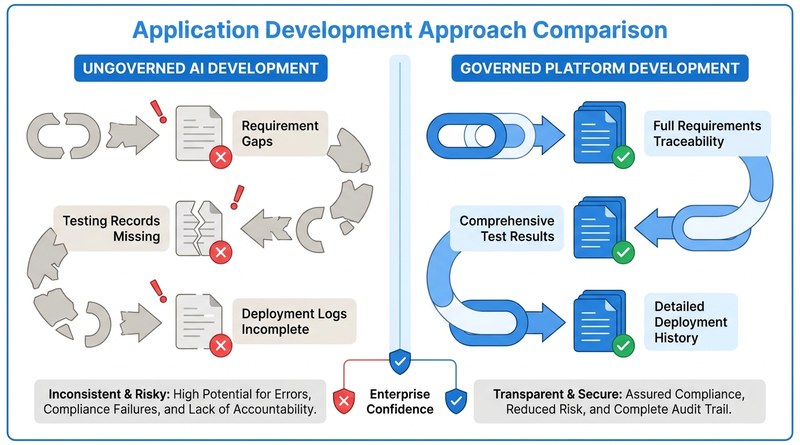
Enterprise IT leaders getting ahead of this are reframing the question. Instead of asking how to document applications already deployed, they are asking how to build new applications in a way that produces governance records as a byproduct of development. CloudApper AI is built around exactly that posture: when an IT director or application owner describes what a workflow or data capture tool needs to do, the AI builds it within a governed platform that maintains the access controls, audit trail, and deployment documentation that compliance reviews will request. The evidence is a structural output of the process. A practical AI coding governance framework for internal development achieves this when governance is built into the development environment itself, not added at audit time.
AI governance board reporting is increasingly requiring CIOs to answer whether their AI-assisted development processes are documented and controlled. ISO 42001 is the forcing function — not because certification is imminent for most enterprises, but because the evidence it defines is the same evidence appearing in customer due diligence, procurement questionnaires, and auditor checklists today. For many IT teams, the gap is not approaching. It is already four months into production.
If your team is building internal applications with AI tools and wants to understand what a governed development process looks like in practice, CloudApper’s team can walk through the specifics with you.

What is CloudApper AI Platform?
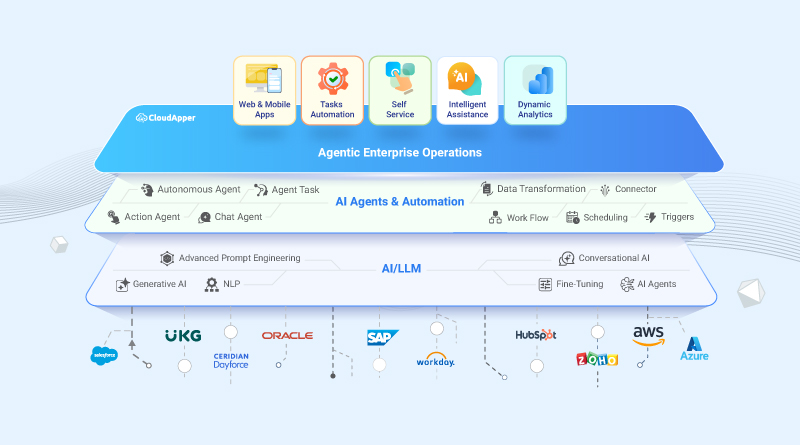
CloudApper AI is an advanced platform that enables organizations to integrate AI into their existing enterprise systems effortlessly, without the need for technical expertise, costly development, or upgrading the underlying infrastructure. By transforming legacy systems into AI-capable solutions, CloudApper allows companies to harness the power of Generative AI quickly and efficiently. This approach has been successfully implemented with leading systems like UKG, Workday, Oracle, Paradox, Amazon AWS Bedrock and can be applied across various industries, helping businesses enhance productivity, automate processes, and gain deeper insights without the usual complexities. With CloudApper AI, you can start experiencing the transformative benefits of AI today. Learn More
- Useful Links:
- Agentic AI
- No-Code/Low-Code
- Custom Software
- HCM Personalization
- iPaaS
- FedRAMP
CloudApper AI Solutions


- Works with









- and more.
Similar Posts

Your Internally Built AI Applications Already Have an EU AI…

NIST AI RMF and Internally Built Enterprise Applications: The Evidence…