Workday overpayment recovery is not the same as arrears. This guide covers what Workday's net pay validation and arrears tools do, where retro pay and completed calculations hit documented limits, why state rules vary, and how CloudApper adds a notice, consent, and installment workflow alongside Workday.

TL;DR
Workday's net pay validation and arrears tools handle deductions that exceed pay, and its documentation does not describe overpayment recovery. Arrears cannot be created from retro pay results and cannot be recouped on a completed pay calculation. State rules on notice, consent, and limits vary and are summarized in a Littler primer from November 2025, so counsel should confirm them first. Classify the cause, set net pay limits and arrears limits, and keep a record of notice and consent. CloudApper AI for HCM Personalization and Extensibility can hold that workflow alongside Workday.
Table of Contents
- What Workday Does Natively
- Where the Friction Shows Up
- What to Do Within Workday First
- Where Native Tools Run Out
Workday overpayment recovery usually gets planned as an arrears problem, and that is where plans go wrong. Arrears tracks a deduction that did not fit inside net pay. An overpayment is money the employer paid in error, and it carries rules arrears was never built to hold. CloudApper AI for HCM Personalization and Extensibility covers the part Workday’s net pay documentation does not describe.
What Workday Does Natively
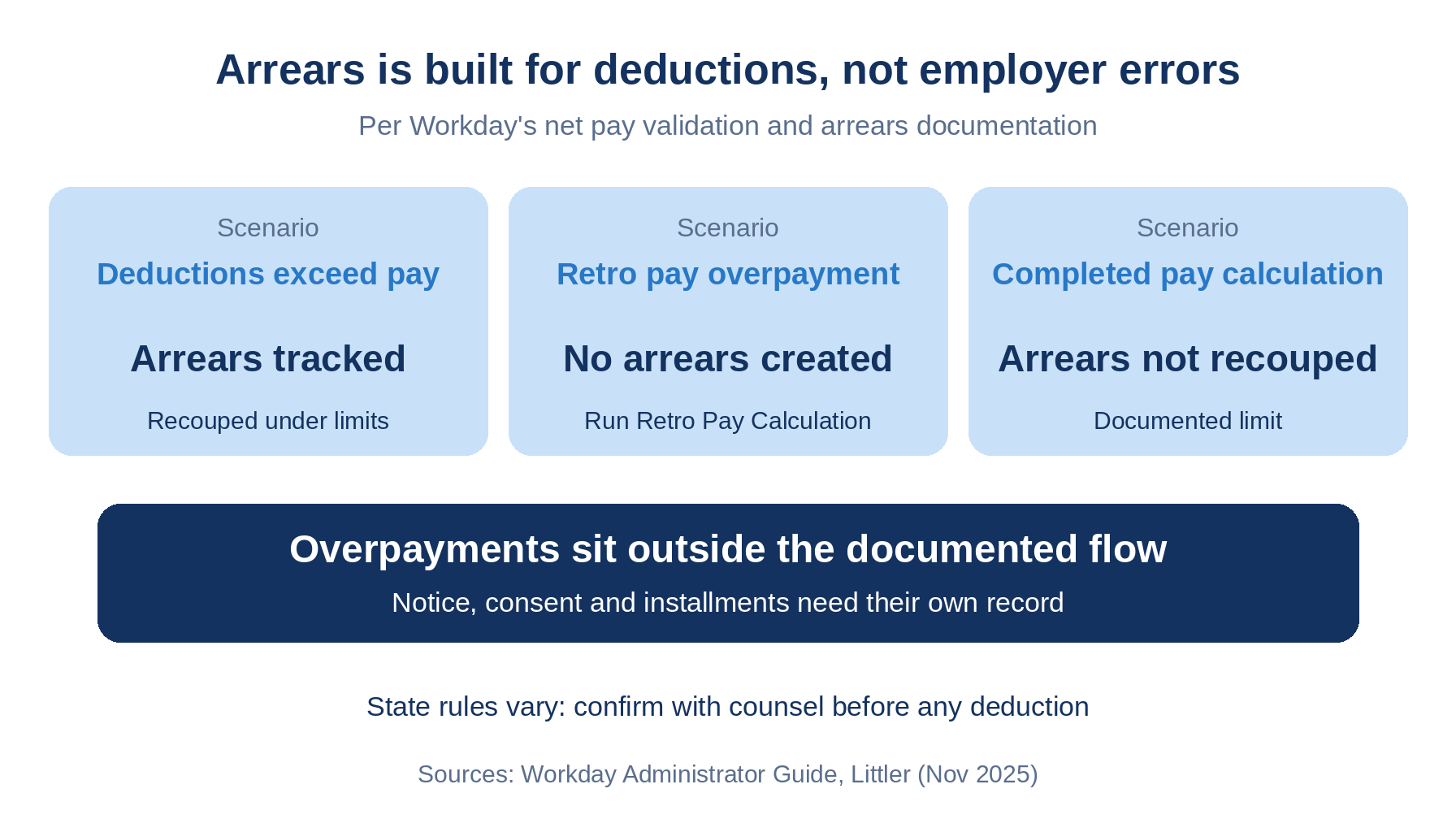
Per Workday’s net pay validation and arrears documentation, the run category carries a minimum net amount, most commonly zero. Deduction priorities decide which deductions are reduced or moved into arrears when pay is short. Arrears can then be recouped from later pay under per-deduction limits, a flat amount or a percentage, with a shared limit across a group of deductions.
Where the Friction Shows Up
- Arrears cannot be created from Run Retro Pay Calculation results, so a retro pay correction that overpays a worker does not become an arrears balance.
- Arrears on a completed pay calculation cannot be recouped, and arrears cannot be recovered from on-demand additional payments.
- The rules live outside the tenant. A Littler primer from November 2025 notes that most jurisdictions do not address overpayment deductions directly, while New York wants advance notice and a chance to challenge, and Washington bars recovery of overpayments not detected within 90 days.
- A recovery deduction competes with benefits, union dues under collective bargaining terms, and garnishments for the same net pay, and low hourly pay after each minimum wage increase leaves little room.
What to Do Within Workday First
- Classify each overpayment by cause: duplicate pay, a rate error, a wrong time entry code, retro correction, or pay after termination.
- Get the state rule on notice and consent from counsel before any deduction, especially across multiple states.
- Set the minimum net amount and deduction priorities so recovery cannot take net pay below policy.
- Set arrears limits for the recovery deduction and keep installments inside them.
- Review the Outstanding Arrears Balance report every cycle.
Former workers need separate handling, because final paycheck rules vary by state, and California’s DIR has said such deductions cannot come from final wages.
Where Native Tools Run Out
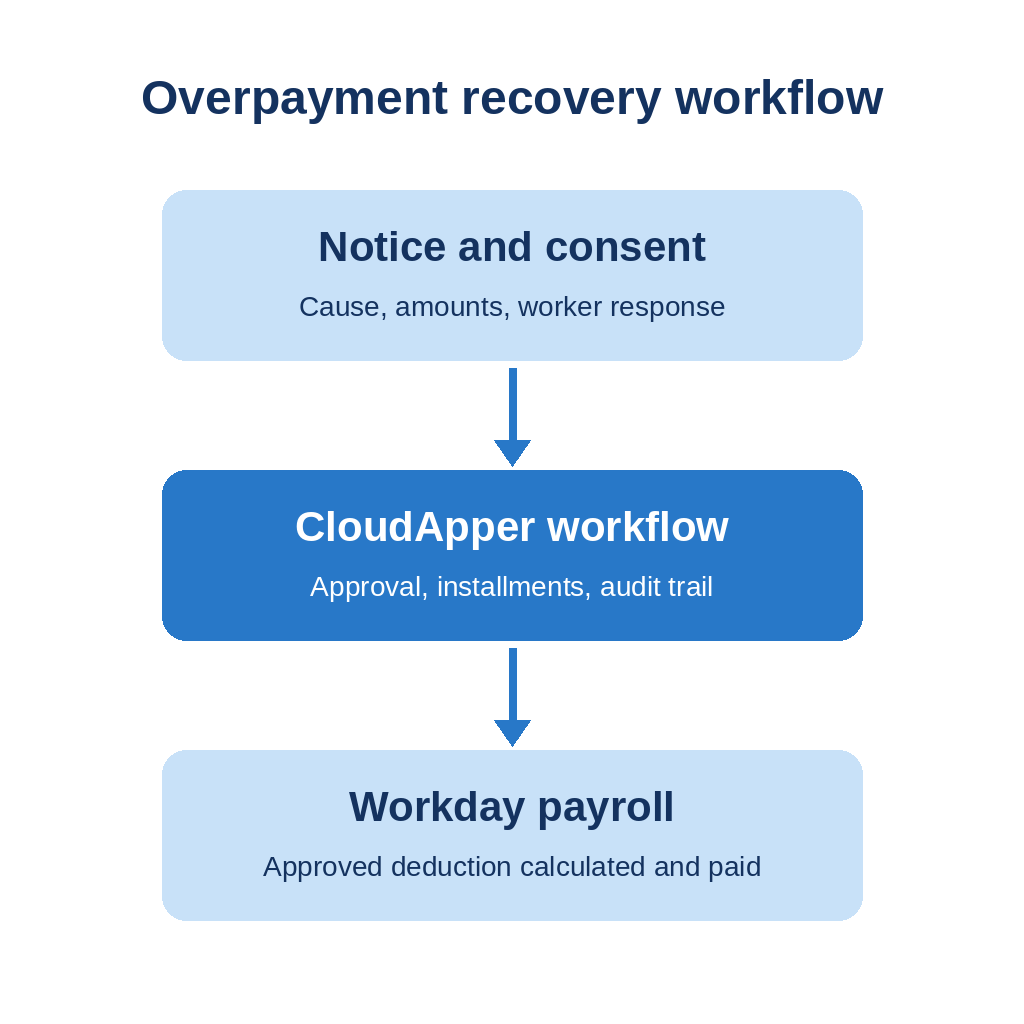
Workday’s net pay pages cover deductions that exceed pay. They do not mention the overpayment itself, the worker’s notice and consent, or an installment agreement tied to it, and that record is what a wage claim or grievance asks for. CloudApper AI for HCM Personalization and Extensibility can hold it.
How CloudApper Closes the Gap
A no-code recovery workflow can capture the cause, pay periods, and gross and net amounts, route approval to payroll and legal, send the worker a notice, record consent or a dispute, and schedule installments before handing Workday an approved deduction. Counsel still decides what the law requires, and Workday still calculates and pays. CloudApper AI for HCM Personalization and Extensibility works alongside Workday, not instead of it.
Frequently Asked Questions
Q: Can Workday recover an overpayment from an employee’s paycheck?

Workday’s documentation describes arrears and recouping for deductions that exceed net pay and does not mention overpayment recovery. Confirm the design in your tenant and the legal rules for the worker’s state.
Q: Is it legal to deduct an overpayment from a paycheck?
It depends on the state. Littler notes that most jurisdictions do not address it directly, while some require notice, consent, or limits. Have counsel review before recovering.
Q: What is negative net pay in Workday?
It occurs when deductions exceed pay. Workday can reduce or eliminate deductions by priority, or track the shortfall as arrears, against the run category’s minimum net amount.
Q: Can arrears be recouped after a retro pay run?
Workday’s documentation says arrears cannot be created from Run Retro Pay Calculation results, and arrears on a completed pay calculation cannot be recouped.
Q: How can an employer recover an overpayment without a deduction?
Littler lists a request for voluntary repayment by separate check or installments, and notes a direct deposit reversal is limited to certain cases, typically within five banking days.
If overpayment recoveries are still tracked in email threads, talk to the CloudApper team about a notice and installment workflow built for your policies.

What is CloudApper AI Platform?
CloudApper AI is an advanced platform that enables organizations to integrate AI into their existing enterprise systems effortlessly, without the need for technical expertise, costly development, or upgrading the underlying infrastructure. By transforming legacy systems into AI-capable solutions, CloudApper allows companies to harness the power of Generative AI quickly and efficiently. This approach has been successfully implemented with leading systems like UKG, Workday, Oracle, Paradox, Amazon AWS Bedrock and can be applied across various industries, helping businesses enhance productivity, automate processes, and gain deeper insights without the usual complexities. With CloudApper AI, you can start experiencing the transformative benefits of AI today. Learn More
- Useful Links:
- Agentic AI
- No-Code/Low-Code
- Custom Software
- HCM Personalization
- iPaaS
- FedRAMP

Brochure
CloudApper AI TimeClock
For accurate & touchless time capture experience.
Download Brochure
CloudApper AI Solutions for Workday



- Works with








- and more.
Similar Posts

Workday Paid Sick Leave Pay Rates: State Rules, Regular Rate,…

Workday Workweek Overtime: Overnight Shifts Across the Week Line