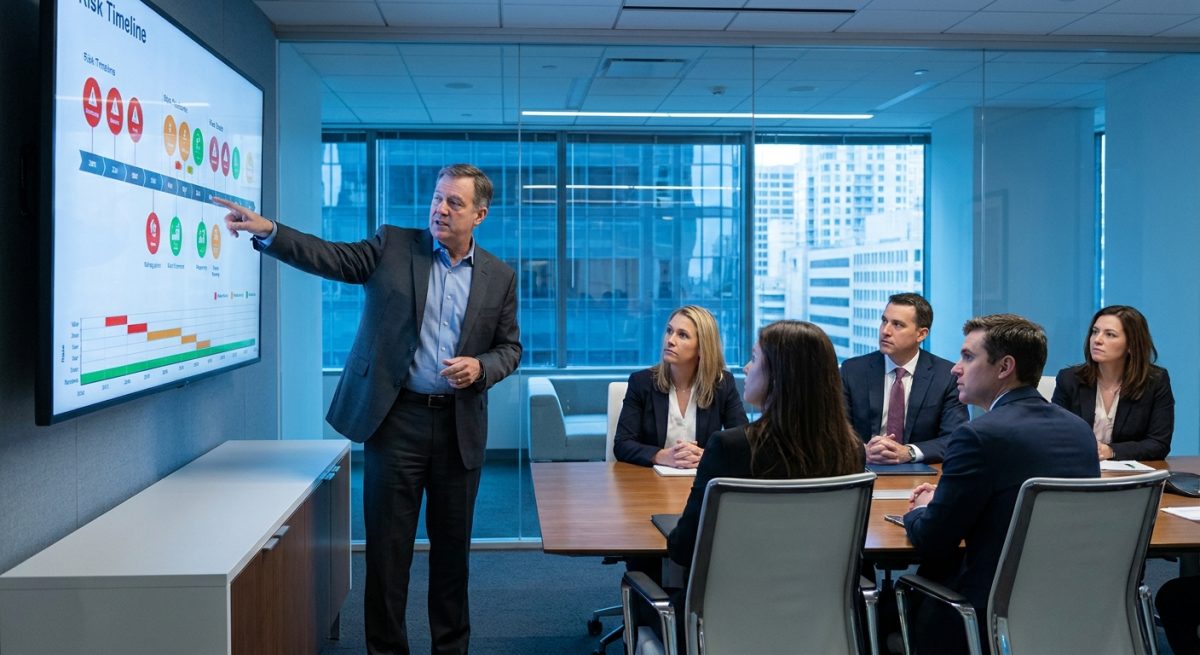
Eight forcing functions that individually represent manageable risk -- and the stacking pattern that breaks the deferral math and makes legacy application modernization the organization's most urgent operational decision.
TL;DR
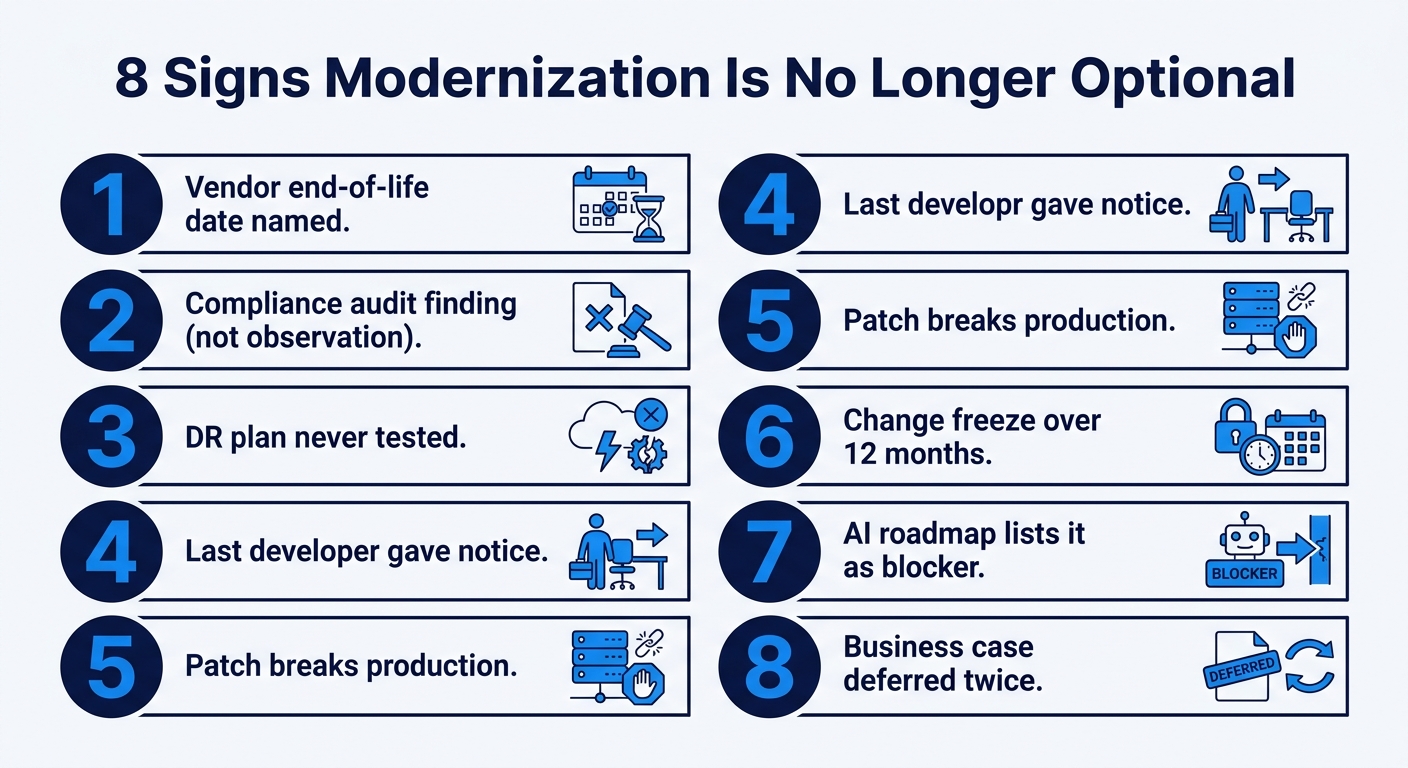
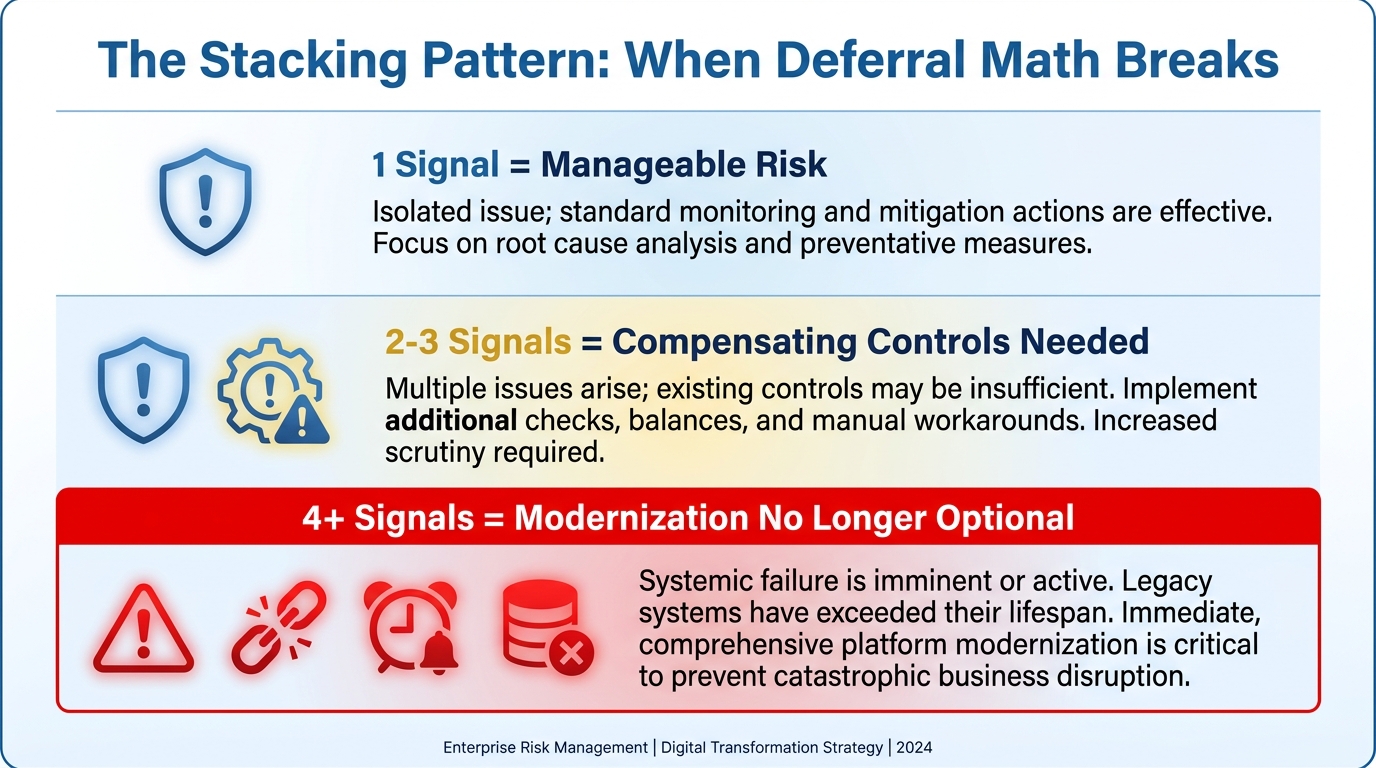
Legacy application modernization is not deferred because organizations lack awareness of risk -- it is deferred because individual signals remain manageable in isolation. Eight specific forcing functions change that calculation: a named vendor end-of-life date, a compliance audit finding with a remediation deadline, an untested DR plan, a departing developer who holds institutional knowledge, a patch that breaks production, a change freeze lasting more than a fiscal year, a legacy system blocking the AI automation roadmap, and a business case that has been deferred twice already. Each is survivable alone. When four or more stack in the same planning cycle, the aggregate risk exceeds what compensating controls can credibly address, and deferral becomes the organization's highest-risk option. CloudApper AI modernizes legacy applications while preserving every business rule, record, and institutional logic from the original system.
Table of Contents
- 1. The Vendor Has Named an End-of-Support Date
- 2. A Compliance Audit Produced a Finding, Not an Observation
- 3. The DR Plan Has Never Been Tested Against the Current State
- 4. The Last Developer Who Understands It Has Given Notice
- 5. A Patch Cannot Be Applied Without Breaking Production
- 6. The Change Freeze Has Lasted More Than One Fiscal Year
- 7. The AI Automation Roadmap Has Listed It as a Blocker
- 8. The Modernization Business Case Has Been Deferred Twice
- When the Signals Stack
The modernization case was deferred eighteen months ago. The budget ask was reasonable, the risk was real, but the timing was wrong — a merger was pending, headcount was frozen, and the system was still running. It was deferred again last spring for similar reasons. Then, in the same quarter, three things happened: the vendor announced end-of-life for the underlying database, a compliance audit flagged the application’s access control gaps as a finding rather than an observation, and the last developer who understood the original codebase gave notice.

None of those three things was new. Each had been visible on the horizon for months. What changed was the stacking — the moment when the organization ran out of room to absorb one more deferral without accepting a material, documented risk it could no longer credibly manage.
What follows are eight signals that individually represent manageable risk. When they stack, they represent the end of the deferral window. This is not a readiness checklist — it is a forcing-function diagnostic. Each signal is the kind of event that moves modernization from a roadmap item to a decision the organization has already made by not acting.
1. The Vendor Has Named an End-of-Support Date
Not a rumor. Not a roadmap hint. A named date, in writing, after which patches, security fixes, and support tickets will not be honored. This is the signal that converts “technical debt” into a dated liability. Organizations running Windows Server 2016, SQL Server 2014, Oracle 11g, or similar end-of-life infrastructure under a business-critical application have a fixed window, not an open deferral. When an underlying platform reaches end of support and the application won’t run on the successor version, the modernization conversation is not about whether — it is about how fast.
2. A Compliance Audit Produced a Finding, Not an Observation
Auditors distinguish between observations (noted, no immediate action required) and findings (documented deficiency requiring remediation with a deadline). When a legacy application generates a finding — on access controls, change management, audit trails, or data classification — the organization has a formal, time-bounded remediation obligation. Deferring modernization now means deferring compliance. The compliance exception log that grows each audit cycle is the balance sheet of deferred decisions, and findings accelerate the compounding.
3. The DR Plan Has Never Been Tested Against the Current State
A disaster recovery plan written three years ago for a system that has since added integrations, changed data stores, and accumulated undocumented dependencies is a plan for a system that no longer exists. When this gap surfaces — in a business continuity review, an insurance audit, or a board-level resilience assessment — it typically produces the same result: a recommendation to modernize rather than document a system too complex to recover predictably. An untested DR plan is not an oversight; it is evidence that the system has outgrown its governance infrastructure.
4. The Last Developer Who Understands It Has Given Notice
This is the signal organizations tend to feel most viscerally but act on least systematically. When the person who wrote the original codebase, knows where the undocumented business rules live, and can explain why a specific stored procedure exists is six weeks from their last day, the organization’s risk profile changes materially. Developer retirement and the SME knowledge cliff is not a staffing problem — it is a risk-register event. The institutional knowledge that lives in one person’s head is the system’s most fragile dependency.
5. A Patch Cannot Be Applied Without Breaking Production
When the security team issues a patch advisory and the answer from application support is “we can’t apply it — the last time we tried, it broke the reporting module,” the compensating control conversation has started. Compensating controls are acceptable for a period with a remediation plan. They are not acceptable indefinitely, and auditors know the difference. When patching breaks production, the organization is managing a system whose security posture cannot be improved without replacing it.
6. The Change Freeze Has Lasted More Than One Fiscal Year
Change freezes are imposed to manage risk on fragile systems. When a change freeze extends through an entire fiscal year, it means the system has been operationally frozen for twelve months while the business it supports continued to evolve. Every workaround, every manual process, every downstream system that adapted to the freeze is technical debt that belongs to the legacy application’s modernization cost. A change freeze that persists is not a control — it is an admission that the system cannot be safely maintained.
7. The AI Automation Roadmap Has Listed It as a Blocker
This signal is newer than the others but arriving faster. When an enterprise’s automation or AI transformation initiative hits a dependency on a legacy system with no API, no structured data exports, and no integration capability, modernization moves from a maintenance conversation to a strategic one. The CTO and the CIO are now in the same room with the same forcing function. A legacy system without an API is not just a maintenance liability — it is the ceiling on every automation initiative that depends on the data it holds.
8. The Modernization Business Case Has Been Deferred Twice
This is the signal that is both most obvious and most often overlooked in a forcing-function analysis. When a modernization proposal has been prepared, presented, and deferred twice, the organization is not lacking information — it is lacking a forcing function that makes the cost of deferral visible in the same meeting as the cost of action. Legacy modernization business cases that keep getting defunded are usually failing at scope estimation, not ROI. The case that gets funded is the one that quantifies the cost of the next twelve months of deferral, not just the cost of the project.
When the Signals Stack
Each of these eight signals is survivable in isolation. Organizations manage end-of-support systems, work around patch conflicts, and absorb audit observations for years. What changes the math is stacking: when three or four of these signals arrive in the same planning cycle, the aggregate risk exceeds what compensating controls can credibly address. That is the moment modernization stops being a roadmap item and becomes the organization’s most urgent operational decision.
When enterprise leaders describe what they need to CloudApper AI, the modernization path starts with requirements extraction — capturing the business logic, data structures, and institutional knowledge embedded in the legacy system before any of it is lost. The result is a modern web and mobile application that preserves every rule and record from the original, without the dependencies that made deferral feel safer than action. Moving a legacy system to a new host is not modernization — and neither is containerizing it. The goal is a system the organization can maintain, audit, and extend without the risk stacking that made this list necessary.
If your organization is carrying two or more of these signals simultaneously, the deferral window is closing. Talk to the CloudApper AI team about what modernization actually takes.

What is CloudApper AI Platform?
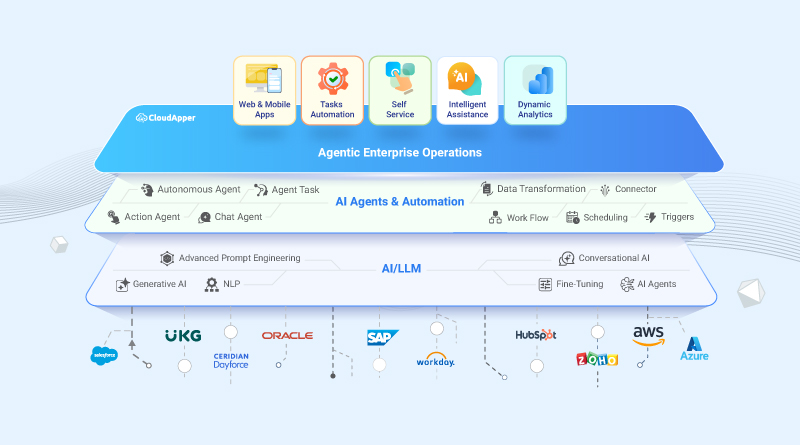
CloudApper AI is an advanced platform that enables organizations to integrate AI into their existing enterprise systems effortlessly, without the need for technical expertise, costly development, or upgrading the underlying infrastructure. By transforming legacy systems into AI-capable solutions, CloudApper allows companies to harness the power of Generative AI quickly and efficiently. This approach has been successfully implemented with leading systems like UKG, Workday, Oracle, Paradox, Amazon AWS Bedrock and can be applied across various industries, helping businesses enhance productivity, automate processes, and gain deeper insights without the usual complexities. With CloudApper AI, you can start experiencing the transformative benefits of AI today. Learn More
- Useful Links:
- Agentic AI
- No-Code/Low-Code
- Custom Software
- HCM Personalization
- iPaaS
- FedRAMP
CloudApper AI Solutions
- Works with








- and more.
Similar Posts

5 HCM Capability Gaps That Keep Landing in IT’s Queue
6 Governance Artifacts Your Enterprise AI Platform Should Produce Without…